
If your business has changed, you may need to decide whether to stay VAT registered or cancel your VAT registration with HMRC.
VAT deregistration is the process of ending your registration for Value Added Tax. Some businesses can apply voluntarily, while for others cancellation becomes a legal requirement.
Businesses expecting VAT taxable turnover below the current £88,000 deregistration threshold may be able to cancel, while the VAT registration threshold is £90,000. Both limits took effect from 1 April 2024 and remain applicable.
At The Taxcom, a Manchester-based tax advisory and accountancy firm, we help businesses assess whether deregistration makes commercial and tax sense before they apply.
This guide explains when HMRC requires you to deregister, how to apply, how your deregistration date affects invoices and returns, what happens to stock and assets, and whether the potential admin and pricing savings outweigh the loss of VAT recovery.
When Can You Cancel Your VAT Registration?
You can ask HMRC to cancel your VAT registration if your VAT taxable turnover is expected to stay below the deregistration threshold. HMRC’s supplement to VAT Notice 700/11 confirms the current cancellation limit is £88,000. The registration threshold is £90,000, so the two figures are £2,000 apart. You can check the registration side in our guide to the current VAT threshold for the UK.
The test looks forward. HMRC wants to know what your taxable turnover will be over the next 12 months, not what it was last year. You may need to give evidence for your forecast, especially if your trade is seasonal or recovering.
This is voluntary deregistration. You do not have to cancel just because you qualify. Many businesses remain registered so they can keep reclaiming VAT on business purchases.
Why Do Businesses Deregister for VAT?
Falling turnover is one of the most common reasons to cancel VAT registration, but businesses may also deregister to simplify their operations. Once registration ends, regular VAT returns and much of the ongoing VAT administration are no longer required, although historic VAT records and liabilities can still be reviewed by HMRC.
Your customer base also matters. A business selling mainly to VAT-registered companies may gain little from deregistering because those customers can generally recover the VAT charged. For a B2C business, however, removing VAT from prices can create a competitive pricing advantage when selling to consumers who cannot reclaim it.
Before applying, calculate the effect on:
-
customer prices and competitiveness
-
input VAT you will no longer recover
-
administrative time and accounting costs
-
your gross margin and profit
-
the likelihood of exceeding the registration threshold again
The potential savings therefore need to be balanced against lost VAT recovery. HMRC’s rules also recognise pricing when considering some cancellation applications, particularly where a retailer’s turnover calculation depends on removing the VAT element from its selling prices.
When Must You Cancel Your VAT Registration?
Compulsory deregistration is different from choosing to leave voluntarily. If you stop making taxable supplies or are no longer eligible to remain registered, cancelling becomes a legal requirement. HMRC requires businesses that become ineligible to notify it within 30 days, and failure to do so may result in a penalty. Common examples are:
-
Ceased trading: your business has ceased trading or stopped making taxable supplies.
-
Sale of the business: a new owner takes over and does not want to keep your VAT number.
-
Change of legal status: if the legal entity changes, for example from a sole trader to a limited company, you must deal with the VAT registration accordingly and inform HMRC. Depending on the circumstances, this may involve cancelling the old registration, registering the new entity or applying to transfer the existing VAT number.
-
VAT group: you join a VAT group, which has its own registration. See our guide to VAT group registration.
You must notify HMRC within 30 days of becoming ineligible. Late notification can lead to penalties, which we cover in our guide to VAT penalties.
How to Cancel Your VAT Registration With HMRC
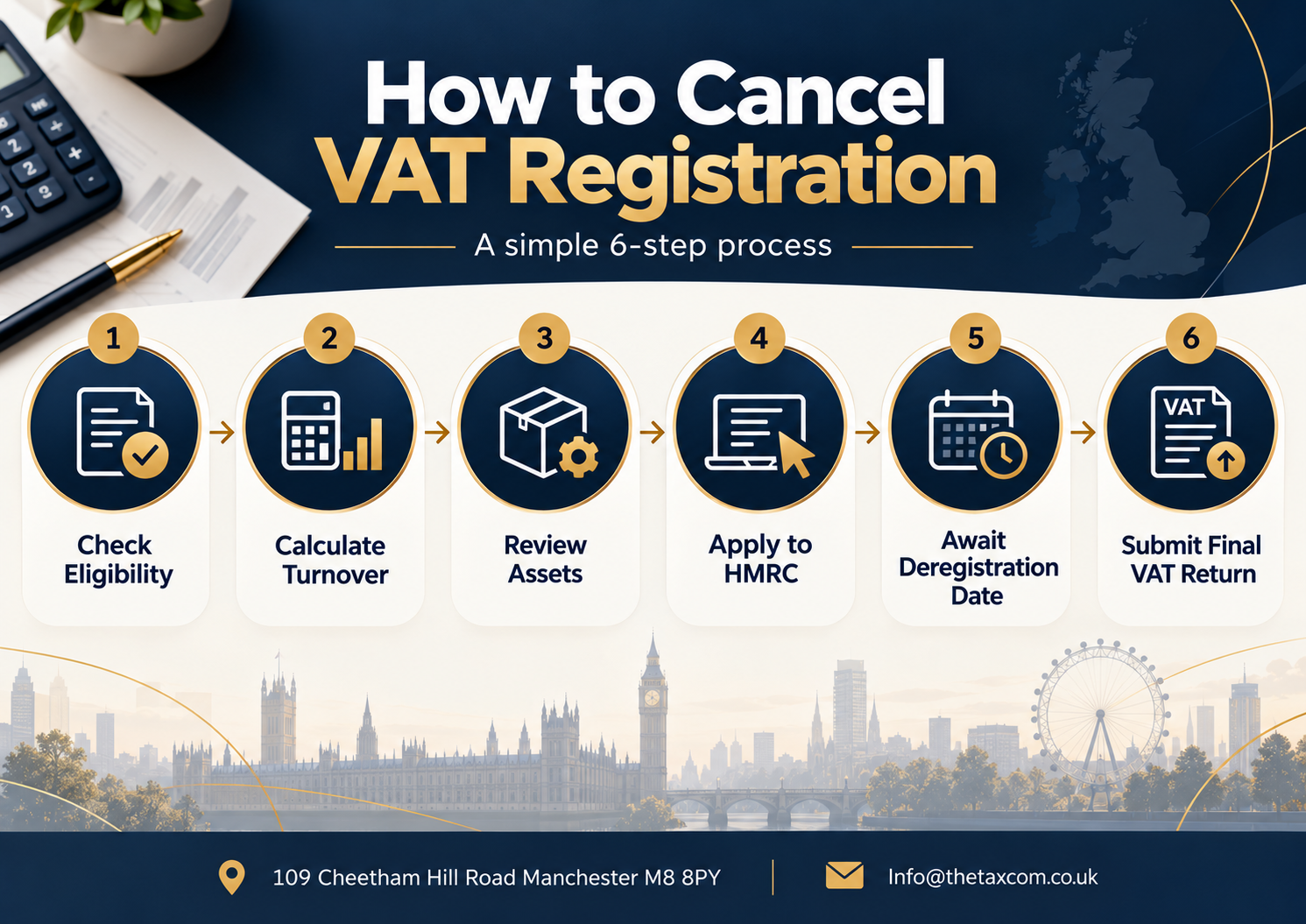
HMRC allows you to cancel your registration online, and an agent can do this for you, although you stay responsible for accuracy. Follow these steps:
-
Check that you meet a deregistration condition, either voluntary or compulsory.
-
Gather your VAT registration number, business details and the reason for cancelling.
-
Choose your requested cancellation date.
-
List your stock and business assets, and note whether you reclaimed VAT on them.
-
Sign in to your VAT account through the Government Gateway and select the cancellation option. Alternatively, send form VAT7 by post.
-
Keep charging VAT until HMRC confirms the cancellation date in writing.
For voluntary cancellation, your requested deregistration date can normally be the date HMRC receives the application or a later date agreed with HMRC. It cannot normally be backdated. Continue charging and accounting for VAT until HMRC confirms that your registration has been cancelled and provides the effective deregistration date.
HMRC advises businesses to contact its VAT Registration Service if they have not heard anything after 40 working days rather than treating 40 working days as a guaranteed processing time.
What Happens to Your Final VAT Return?
You must submit one final VAT return covering the period up to your cancellation date. Include all outstanding VAT returns and pay any VAT due. Do not delay the return while you wait for supplier invoices. If invoices arrive later, you can claim the input VAT afterwards on form VAT427.
From the cancellation date you must stop charging VAT and stop issuing VAT invoices. Remove your VAT number from invoices, your website and stationery. If you remain VAT registered in error, HMRC may require you to account for VAT you should not have charged.
At The Taxcom, our VAT Services team regularly prepares final VAT returns for clients, checking that every outstanding return is filed and every figure reconciles before submission.
VAT Records You Must Keep After Deregistration
Once HMRC confirms the date, your registration ends from that effective date and you should stop charging VAT in accordance with the cancellation rules.
Cancelling VAT registration does not mean you can dispose of your previous VAT records. Businesses generally need to retain VAT records until the applicable six-year retention period has expired, even if they are no longer registered. HMRC’s cancellation confirmation should also be kept as part of those records.
You should also keep details of the business assets held on your deregistration date and their values. These records can be important if HMRC later checks your final VAT return or the VAT accounted for on remaining stock and assets.
Do You Pay VAT on Stock and Business Assets?
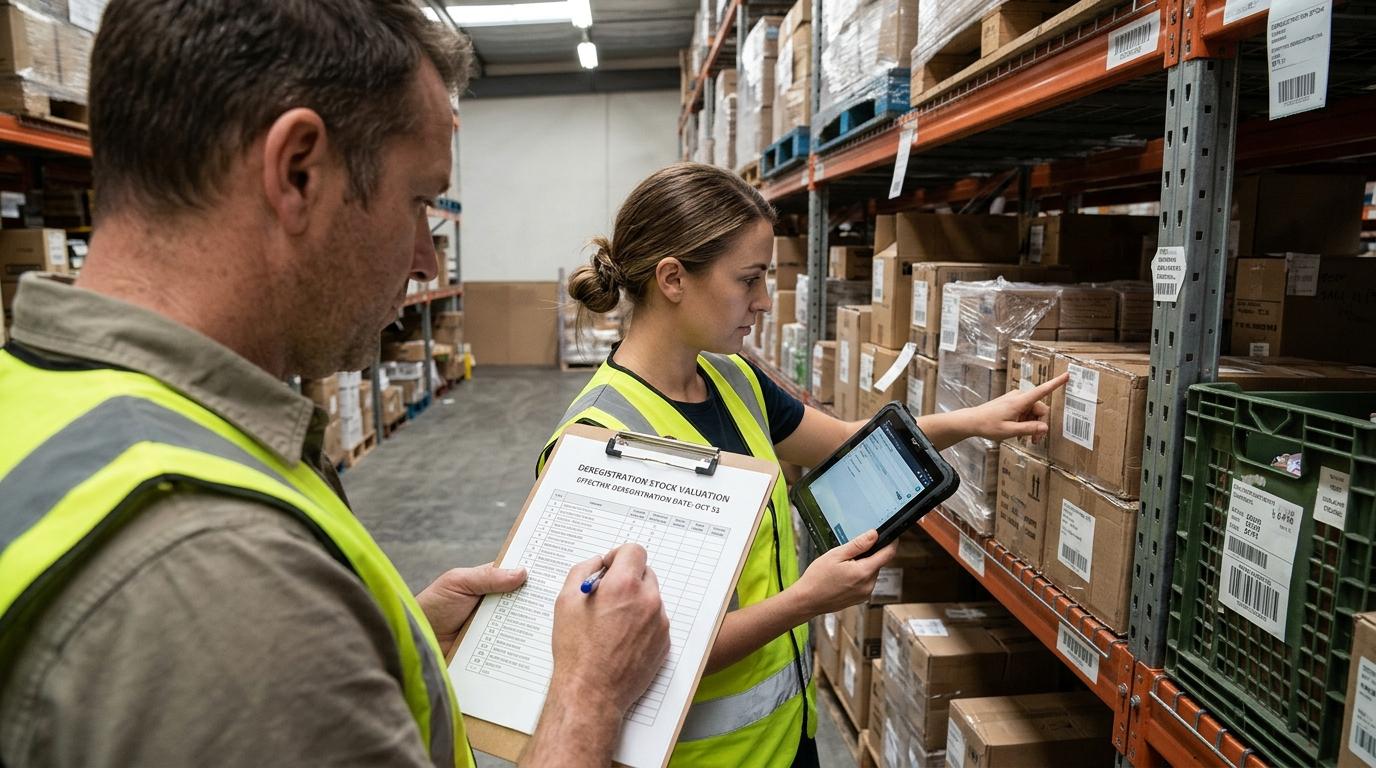
Possibly. You may have to account for VAT on stock and business assets you still hold on the cancellation date, if you reclaimed VAT when you bought them. No charge arises if the total VAT due on those items is £1,000 or less.
The charge is added to your final VAT return as output tax. To understand how input and output VAT interact, read our guide to input VAT vs output VAT. Property owners should take extra care, because an option to tax can create a charge on land and buildings.
Worked Example
Sam runs a small design studio and expects taxable turnover of £70,000 over the next 12 months. That is below the £88,000 limit, so Sam applies to cancel. On the cancellation date, Sam holds a computer and printer bought for £6,000 plus £1,200 VAT, which Sam reclaimed. Sam also holds stock with £400 VAT.
|
Item |
VAT reclaimed |
|---|---|
|
Computer and printer |
£1,200 |
|
Stock |
£400 |
|
Total VAT due on assets |
£1,600 |
The total is over £1,000, so Sam must pay the £1,600 on the final VAT return. If the total had been £900, nothing would be due.
Should You Stay VAT Registered or Cancel?
|
Factor |
Remain registered |
Cancel registration |
|---|---|---|
|
Charging VAT |
You charge VAT on taxable supplies |
You stop charging VAT |
|
Reclaiming VAT |
You can reclaim input VAT |
You can no longer reclaim VAT |
|
Admin |
VAT returns continue |
No more VAT returns |
|
Best for |
Customers who are VAT registered |
Customers who are consumers |
If most customers are VAT registered, they can reclaim your VAT, so staying registered often makes commercial sense. If you sell mainly to the public, cancelling may let you cut prices or keep more margin.
We at The Taxcom often run projections for clients comparing both options before they apply, using our Tax Advisory experience to weigh up lost VAT recovery against the admin saved. That avoids cancelling and then having to re-register soon afterwards. If you do re-register, you will normally receive a new VAT number.
Common VAT Deregistration Mistakes
-
Stopping VAT on invoices before HMRC confirms the cancellation date.
-
Missing the 30-day notification deadline after you stop trading.
-
Forgetting to include VAT on stock and business assets in the final return.
-
Assuming an overseas business can use the £88,000 limit. Non-established taxable persons can only cancel once they have completely ceased making taxable supplies in the UK.
-
Failing to tell HMRC about a change in legal status or another change affecting the VAT registration.
-
Discarding VAT records after deregistration instead of retaining them for the required period.
-
Leaving outstanding VAT returns unfiled.
Getting Your VAT Cancellation Right With The Taxcom
Cancelling is simple on paper, but the final VAT return is where errors happen. We, at The Taxcom can help you calculate VAT on remaining assets, choose the correct deregistration date, complete a final return and decide whether the savings from deregistration outweigh lost input VAT recovery.
-
If you are unsure whether staying registered or cancelling is better for your profit and pricing, our Tax Advisory team can compare both options based on your turnover, costs and customer base.
-
If HMRC questions your deregistration, final return or historic VAT position, our VAT Investigations specialists can help you respond.
VAT Deregistration FAQs
What is the VAT deregistration threshold?
It is £88,000 of expected VAT taxable turnover over the next 12 months. The registration threshold is £90,000.
Do I have to cancel my VAT registration if turnover falls?
No. Falling below the threshold makes you eligible to cancel voluntarily, but you can remain registered if that suits your business.
Can I backdate my cancellation date?
No. For voluntary cancellation, the date can be when HMRC receives your application or a later agreed date, but never earlier.
Do I keep charging VAT after I apply?
Yes. You must keep charging and accounting for VAT until HMRC confirms the cancellation date.
Can I re-register for value added tax (VAT) later?
Yes. You can re-register if your turnover passes the registration threshold or you choose to register voluntarily. You will usually get a new VAT number.
Can I reclaim VAT on costs after cancelling?
Generally no. You can claim input VAT on late supplier invoices using form VAT427, but you cannot reclaim VAT on new costs once cancelled.
Speak to The Taxcom About Cancelling Your VAT Registration
Your next step is to confirm whether cancelling really suits your business. Our VAT Services team can review your turnover forecast, assets and final VAT return before you apply. Speak to The Taxcom before your VAT registration ends so you know what needs to be reported, paid and retained.
Book a personal consultation with our taxation experts.
Note: This is general guidance, not professional advice. Contact our tax advisors for personalised advice.